
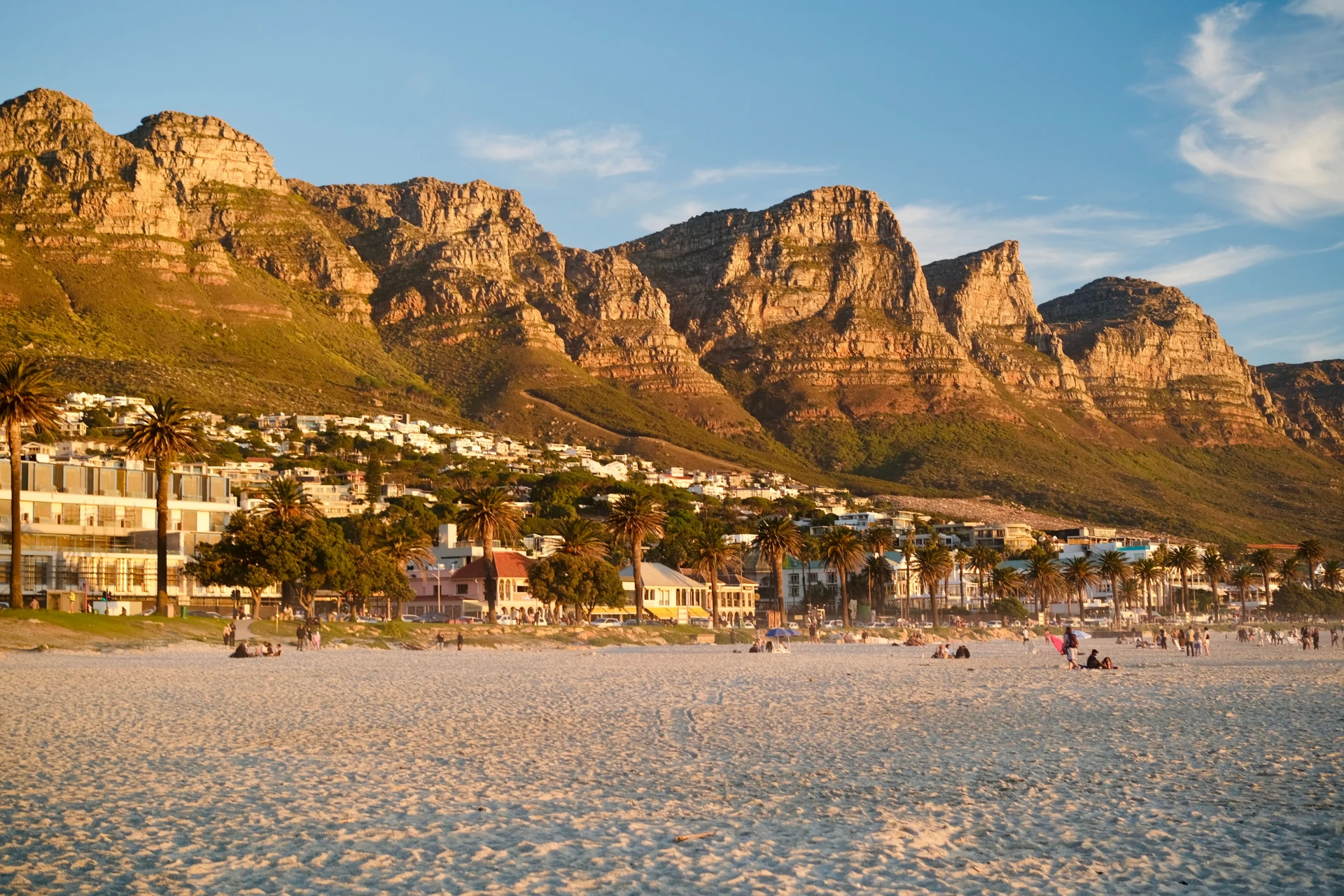
Camps Bay Beach is the wide, white arc of sand that gives the suburb its name and its reputation. Backed by the granite buttresses of the Twelve Apostles and flanked by Lion’s Head, it is the most recognisable beach on Cape Town’s Atlantic Seaboard and, for most visitors, the first place they walk to after dropping their bags.
It sits directly across Victoria Road from the restaurant strip, which is the practical genius of the place. You can swim, dry off on the sand, and be seated for lunch within five minutes without moving your car.
What to expect
The beach runs roughly 700 metres end to end and is unusually deep, with a broad grassy verge and a palm lined promenade between the sand and the road. Rocky outcrops divide it into distinct sections that merge in summer as sand builds up, which is why you will sometimes hear it described as four beaches rather than one.
The sand is fine and pale, the water is a startling blue, and the mountain backdrop means the light changes character through the day. It is busy, sociable and unapologetically glamorous, particularly from December through February.
Swimming and water conditions
This is the Atlantic, cooled year round by the Benguela Current, so the water sits somewhere between roughly 12 and 18 degrees Celsius depending on the season and the day. Peak summer can touch 20 degrees. It is bracing rather than comfortable, and most people wade, cool off and retreat rather than swim lengths.
The shore break can be powerful and there is noticeable backwash on bigger days. Swim between the red and yellow flags where lifeguards have marked the bathing area, and if you want calm water, walk to the tidal pool at the southern end instead.
Blue Flag status and lifeguards
Camps Bay holds Blue Flag accreditation, an international standard covering water quality, environmental management, safety and facilities. Worth knowing: the beach as a whole carries the status, but only the demarcated section marked by lifeguards is the designated bathing area.
Lifeguards are on duty through the summer season, generally from 10am to 6pm. Outside those months there is no guarantee of cover, so take extra care.
Facilities
- Public toilets, showers and changing rooms beside the lifeguard tower
- Sun loungers and umbrellas for hire in season
- Beach volleyball courts
- Grassy verge for picnics and shade
- Level paved promenade access, easier for wheelchairs and prams than the stair access beaches at Clifton
Parking and getting there
Street parking along Victoria Road and the side streets is free, managed informally by car guards who it is customary to tip a small amount on your return rather than upfront. It fills fast on hot days and summer weekends. Arrive before mid morning or use a ride hailing app.
If anyone demands a fixed hourly fee for street parking, that is not an official charge.
The MyCiTi bus routes 106 and 107 connect the city centre to Camps Bay via Kloof Nek, terminating on Victoria Road.
Best time to visit
November to March for reliable beach weather. Before 10am for space, quiet and the calmest water of the day. Late afternoon into sunset for the reason people photograph this beach more than any other in the city.
The afternoon South Easter, the wind Capetonians call the Cape Doctor, is the main variable in summer. Camps Bay gets some shelter from Lion’s Head and the Twelve Apostles but is still exposed on a strong day. Mornings are usually calmer.
Local tips
- Bring a windbreak in summer. The South Easter arrives suddenly in the early afternoon.
- The southern end near the tidal pool is generally quieter than the central stretch opposite the restaurants.
- Sunset happens fast. Be in position twenty minutes before.
- Dogs are restricted during peak daytime hours in season. Check current signage before bringing one.
Between June and November, Southern Right and Humpback whales migrate along the Western Cape coast. Sightings from the Atlantic Seaboard are opportunistic rather than reliable, so treat any whale you spot from the sand as a bonus.