
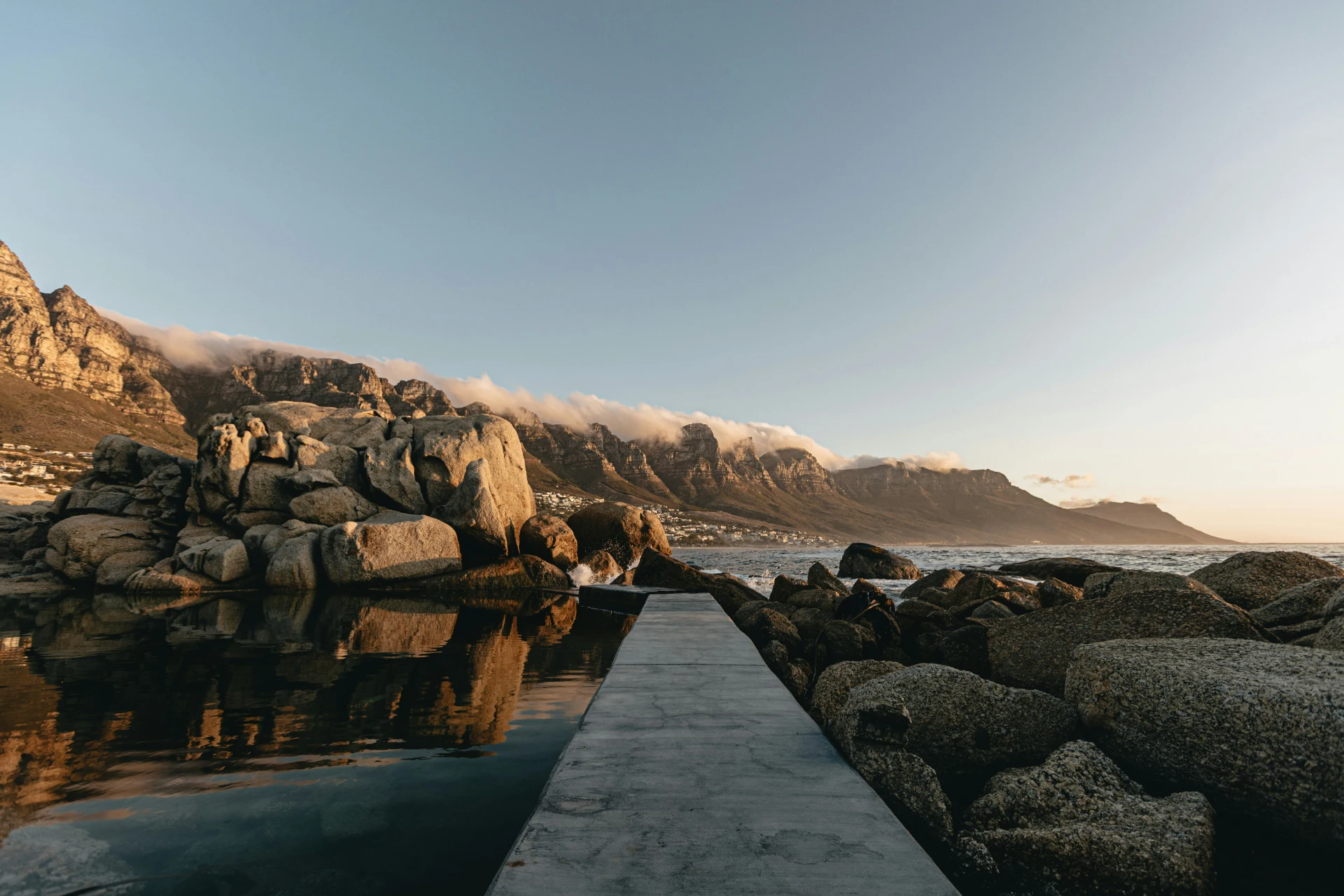
Between Glen Beach and Clifton Fourth, a headland of enormous granite boulders juts into the Atlantic. This is Maiden’s Cove: two tidal pools, a small beach, grassy lawns, built in braai spots and one of the finest free sunset positions in Cape Town.
It is a municipal recreation area rather than a resort beach, and it draws a strong local crowd. Families arrive with cooler boxes and charcoal, swimmers use the pools, and the boulders fill up in the last hour of light.
The setting
The views are the point. You get the Twelve Apostles rising behind you, the sweep back towards Camps Bay in one direction and Clifton in the other, and open Atlantic straight ahead. The boulders are flat enough in places to lie on, which is how most people use them.
It is also one of the better free diving and snorkelling spots on the peninsula when conditions are calm.
The tidal pools
There are two pools here, both larger and generally quieter than the Camps Bay pool. The water is sheltered by rock, the entry is an easy wade, and they suit children well. As everywhere on this coast the water is cold, so expect short swims.
History worth knowing
Maiden’s Cove carries real cultural weight. During apartheid it was one of very few coastal spaces where Cape Town’s Black, Coloured and Indian residents were permitted to enjoy the sea, while Clifton and Camps Bay were reserved for white use. It remains a cherished space for communities from the Bo-Kaap and the Cape Flats, and that history is part of why proposals to develop it have met such sustained public resistance.
A large mixed use development was proposed for the precinct and was contested in the Western Cape High Court by heritage groups, bungalow owners and a public access campaign. Visitors should expect the cove to remain in its current public, natural state.
Facilities
- Free to enter, open at all hours
- Two tidal pools
- Public toilets
- Built in braai facilities and grassy picnic lawns
- Dedicated parking area
Best time to visit
Mid week if you can. Summer weekends and public holidays are genuinely busy, and the braai spots go early. Late afternoon into sunset is the signature experience.
Between June and November, Southern Right and Humpback whales pass along this coastline, and the elevated headland is one of the better vantage points on the Atlantic Seaboard from which to look for them. Dolphins are seen here more reliably than whales.